Spec work · 2026

Inside a scroll compressor

A 34-second technical animation of the part of a heat pump that nobody ever sees.

Type
Spec work, illustrative
Format
1 × video, 16:9, 0:34
Language
Czech (on-screen text)
Made with
Claude Opus 5.5 · Python · three.js · Remotion · Adobe Firefly

The film

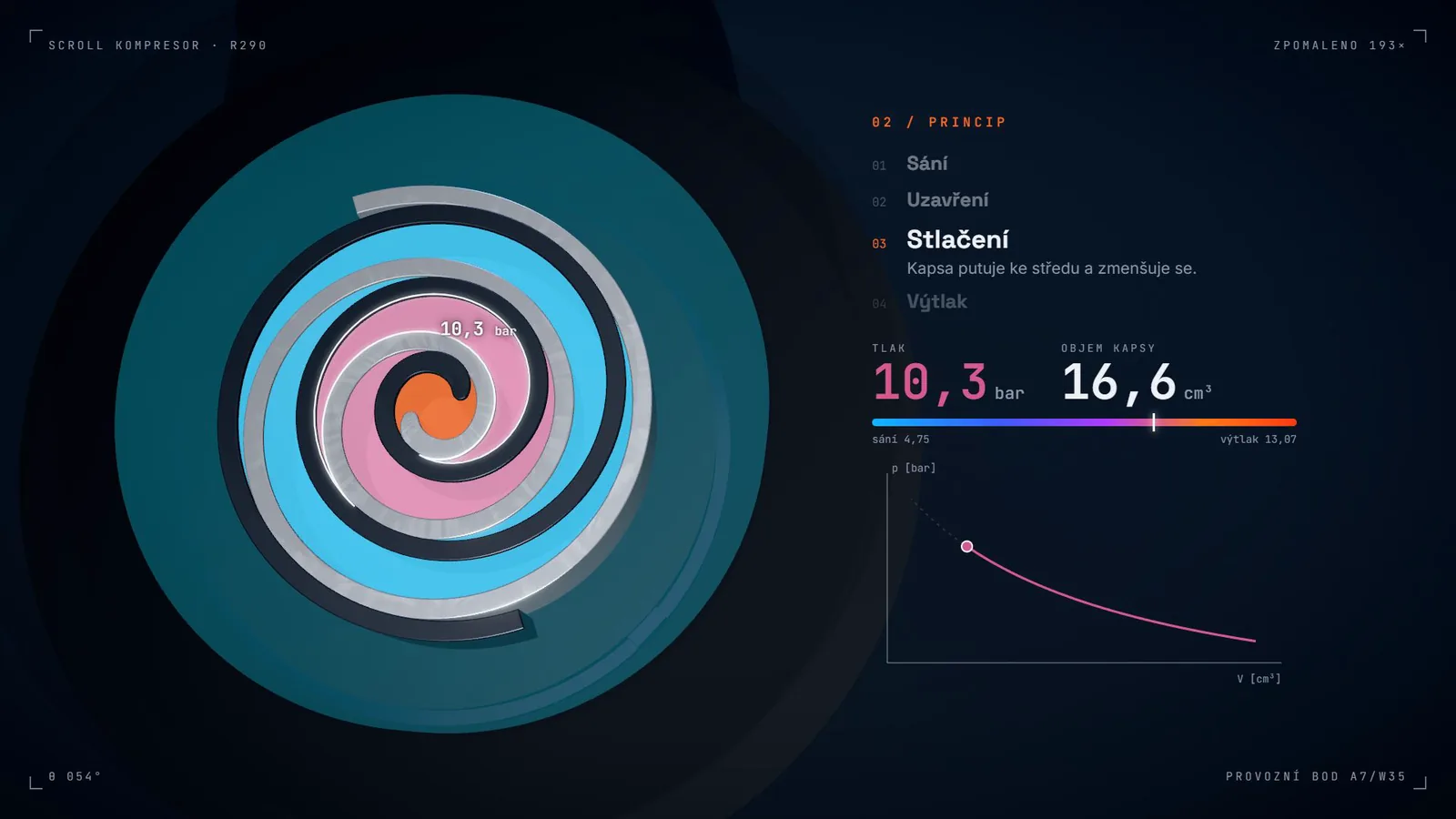
Top view of the two scroll spirals with gas pockets coloured by pressure and a live readout of 13.0 bar Play · 0:34

On-screen text in Czech. Shown 193× slower than real life: in a running heat pump the spiral orbits 48 times a second.

What's on screen

  1. The shell. “The heart you'll never see”: 2,900 revolutions a minute, inside a hermetically welded shell.
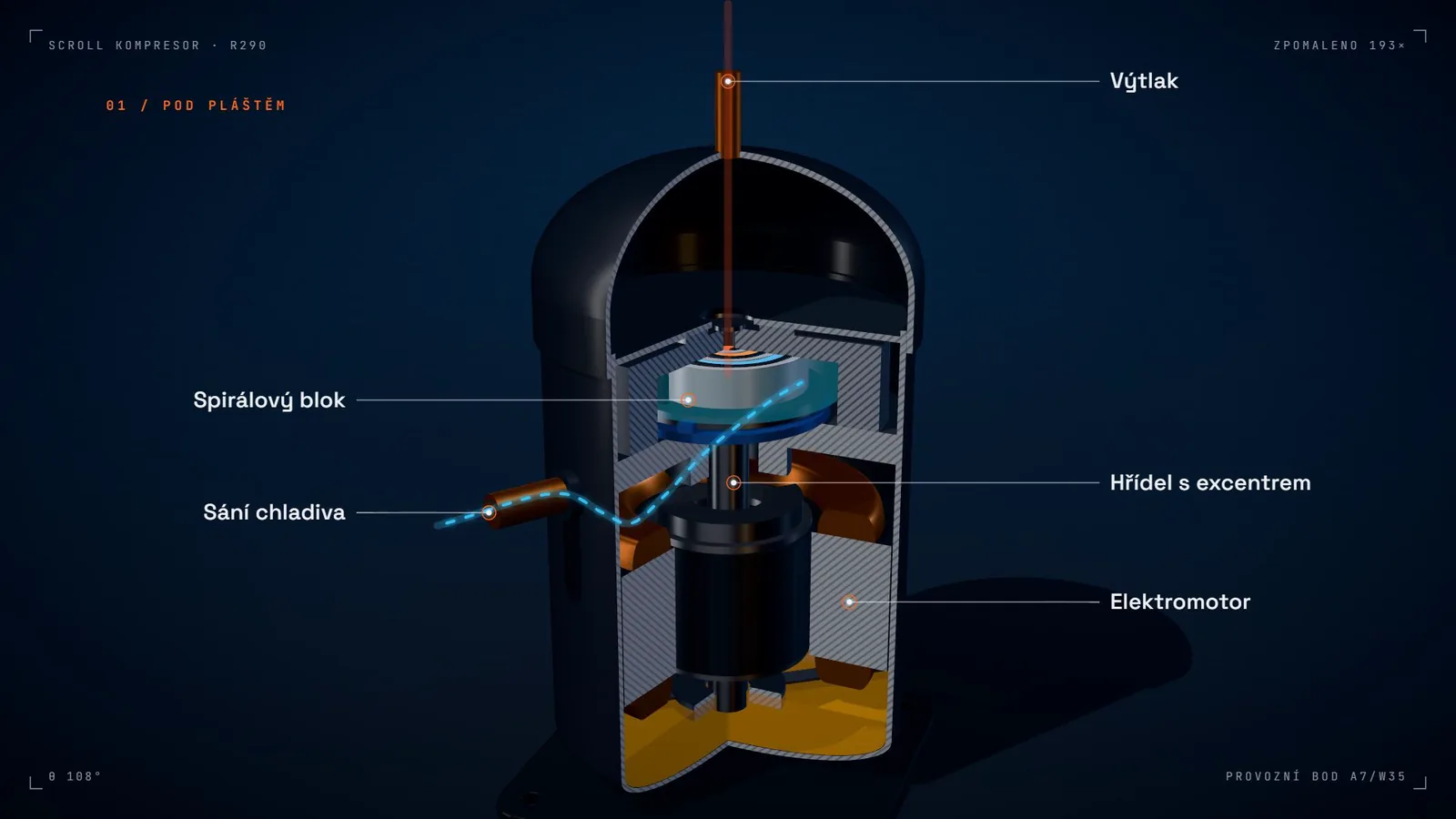
  2. Under the shell. A cutaway with the suction inlet, discharge tube, scroll set, shaft and motor labelled.
  3. Two spirals. One stands still, the other orbits. The Oldham coupling stops it turning on its own axis, so it only travels round a 5 mm circle.
  4. The principle. Suction, closure, compression, discharge. One pocket of gas is tracked from 4.8 to 13.0 bar and from 33.5 to 13.4 cm³, with a live pressure–volume chart.
  5. Why scroll. No suction valves, three main moving parts, and up to four pockets compressing at once.

Who made what

AI-generated
The music, made with Adobe Firefly. No generated images or video: every frame is rendered from code.
Concept & words
Claude Opus 5.5 and me, with a separate AI review of the technical claims and the Czech on-screen text.
Build & edit
Claude Opus 5.5 wrote the geometry engine in Python and the 3D scene, animation and graphics as code (three.js in Remotion). I directed and reviewed every version and added the music.
The project

Some products do all their work where no customer can see it. A scroll compressor is one of them. It sits inside a welded steel shell at the heart of a heat pump, and its spiral orbits 48 times a second. A product photo shows a black cylinder; a datasheet shows numbers. Neither explains why it works.

This film opens the shell, takes the two spirals apart and follows a single pocket of refrigerant from the edge to the centre. On the way its pressure rises from 4.8 to 13 bar and its volume shrinks from 33.5 to 13.4 cm³, live on screen. It closes on three facts a sales engineer would want a customer to remember.

It is a spec piece, not client work. The compressor is a generic, illustrative design, not any manufacturer's product. The physics is real.

Built from the documentation

The question behind this piece was whether Claude Opus 5.5 could take dense engineering documentation — equations, a patent, datasheets, refrigerant tables — and turn it into an explainer that is both correct and watchable. The film was built from these sources:

From these, Claude built a geometry engine that calculates the spiral walls, the volume of every gas pocket at every degree of rotation, when each pocket closes and opens to the discharge port, and the pressure inside it. The measured values on screen — pressures, pocket volumes, the crank angle — come out of that engine rather than being typed in.

Cutaway of a hermetic scroll compressor with labelled suction inlet, scroll set, shaft and motor
The parts follow a standard low-side hermetic layout, as described in the Copeland patent. Suction gas enters the shell at the side and cools the motor on its way up to the scroll set.

How it was checked

Before publishing, the numbers were checked twice. The pocket volumes the engine computes match PDSim's closed-form equations to within 0.01 %, and the two spiral walls never collide over a full revolution. The refrigerant pressures were recalculated independently, and a separate review pass went through every claim and every Czech term on screen.

The three facts at the end each rest on a source: scroll compressors need no suction valve; Carrier's training material counts three main moving parts; and the number of pockets compressing at once follows from the geometry itself.

For your product

The approach suits products whose value is hidden inside: pumps, valves, sensors, filters, heat exchangers, dosing systems. For a real product I would work from:

A film like this carries its information on screen rather than in a voice-over, so it can loop silently on a trade-fair stand as well as sit on a product page, open a sales deck or support training.

Work together

creator [at] igorbrezina.cc